Play · Growth · Human Flourishing·Powered by AI
Moses Silbiger, MA
Researcher - AI · Interactive Entertainment · Developmental Psychology

Interactive Entertainment


The VEHICLE

Interactive Entertainment
Evolution: 2008-2026 (current 'Zeitgeist')
Where the field is today, and what becomes possible when you add the missing piece

What's Inside



The Gap Nobody's Looking For
Extraordinary tools, exponential tech growth, no map for human development integration

"I believe that video games can be a force for good in the world. They have the power to educate, inspire, and bring people together.."
- Shigeru Miyamoto, legendary creator of Super Mario and The Legend of Zelda
Something remarkable is happening in interactive entertainment right now. The industry is building tools of extraordinary sophistication -
experiences that adapt to you in real time, immersive environments that can shift how you feel and think, AI systems that learn your patterns and respond
to your emotional state.
The technical infrastructure for something genuinely transformative is being assembled, piece by piece, at massive scale.
And almost none of it is being pointed at human development.
Not because the people building it don't care about humans. But because they're not looking through that lens.
The framework isn't there. The question isn't being asked.
That is exactly the gap that Press Play to Grow! was designed to fill - in 2008, and even more so today.
Interactive Entertainment is the vehicle, the medium Press Play to Grow! has always pointed toward - arguably the most widely used, engaging, and technically sophisticated medium millions of people interact with every day, through different channels.
Press Play to Grow! is built on the same logic.


Nobody Knew They Needed an iPhone Either
The iPhone moment for human flourishing:
Tech development meets human development
""People don't know what they want until you show it to them." - Steve Jobs
When Steve Jobs introduced the iPhone in 2007, he wasn't responding to consumer demand. No one was asking for it. No one knew to ask.
The iPhone wasn't a better phone, or a better camera, or a better way to browse the internet. It was something new that emerged from the convergence
of all three - and that convergence produced an experience that none of the parts could have created separately.
Press Play to Grow! is built on the same logic.
People are not asking for interactive entertainment designed to catalyze human development. They don't know to ask. The experience doesn't exist yet.
But that's not because the need isn't there - it's because no one has yet brought the right pieces together in the right way.
Those pieces are now on the table: a mature and expansive interactive entertainment industry, AI systems capable of reading and adapting to individual
human beings in real time, and a developmental psychology framework sophisticated enough to map the full range of human potential.
None of these fields, on their own, could produce what PPG envisions. Converged, they make it possible for the first time.
The iPhone moment for human development through interactive entertainment hasn't happened yet. That is what Press Play to Grow! is pointing toward.


Game Design Today - A Discipline Comes of Age
From mechanics and graphics to narrative, emotion, and human experience - 2008 to now

In 2008, game design as a formal discipline was still finding its academic and professional footing.
The questions being asked at GDC, at Games Learning Society, at Meaningful Play were radical at the time: can games tell meaningful stories?
Can they produce genuine emotion? Can they change how people think and feel?
Those questions have since been answered - emphatically, by the games themselves.
From Spectacle to Story
The period from 2008 to 2026 saw a fundamental shift in what game design prioritizes. The industry moved from a primary focus on graphics, physics, and technical spectacle toward narrative depth, player agency, moral complexity, and emotional resonance. Games like The Last of Us (Naughty Dog), Red Dead Redemption 2 (Rockstar), Disco Elysium (ZA/UM), Hades (Supergiant Games), and Celeste (Maddy Thorson) demonstrated that interactive experiences could carry genuine literary and emotional weight - and that players would seek them out, pay for them, and remember them in the way they remember formative life experiences. In 2025, narrative-driven games have become more immersive than ever, offering branching storylines that adapt to player decisions - creating personalized experiences where each player's journey differs based on their choices
Player Agency and Moral Complexity
One of the most significant shifts in game design since 2008 has been the deepening treatment of moral complexity and player agency. Where games once offered binary good/evil choices, the most sophisticated titles now present genuinely difficult decisions with no clear right answer - forcing players to confront their own values, assumptions, and blind spots. This is developmental territory. A player who has spent 40 hours navigating the moral landscape of a well-designed game has done something that no lecture, course, or training program could replicate: they have made choices, lived with consequences, and been changed by the experience. This is the Trojan Horse in action - development that does not announce itself.
The Democratization of Game Design
The rise of accessible game engines - Unity and Unreal Engine in particular - has transformed who can make games and at what scale. The game creation process has evolved dramatically, transforming both production methods and gameplay design, enabling deeper narrative integration and more interactive experiences while enhancing visual fidelity and gameplay complexity. What once required a studio of hundreds can now be achieved by a team of two or three - or even one designer with a vision. This democratization has accelerated experimentation, diversity of perspective, and the willingness to take risks on unconventional ideas - exactly the conditions that produce the kind of meaning-driven games that matter most for Press Play to Grow!'s vision.
The Designer as Systems Architect
The role of the game designer itself has evolved. As Hilary Mason, co-founder and CEO of game technology studio Hidden Door, noted: "game developers become more like the directors of a play, rather than the actors or the writers. It's more about deciding the arc and setting up all the pieces and allowing the systems and the players to provide the context and the details of the experience."This shift - from author to architect - maps directly onto what Press Play to Grow! proposes: a designer who sets the developmental conditions, and trusts AI
and the player to navigate them.Since 2025, Mason's Hidden Door has been building on that idea directly, developing a generative-narrative game engine that combines large language
models with a conventional game engine to track structured character state across a session. It is, in practice, the designer-as-systems-architect model
she described, now built in software.
Academia Takes Notice
Academic validation followed a similar arc. Jesse Schell is Distinguished Professor of the Practice of Entertainment Technology at Carnegie Mellon University and CEO of Schell Games. He delivered the exhibition keynote at CHI PLAY 2025.CHI PLAY is the leading academic conference on games and human-computer interaction.
His keynote was titled 'News from the Future: Videogames from 2026 to 2035.' It extended his developmental design frameworks a decade forward.
His studio separately published an applied analysis. It used his own 'Lens of Emotion' framework. The analysis illuminated the grief-design architecture of
Clair Obscur: Expedition 33, connecting elite indie craft to the theoretical vocabulary Schell has spent two decades building.That same year, Clair Obscur: Expedition 33 dramatized the emotional potential of small, intentional design. It was built by a team of roughly 30 at French
studio Sandfall Interactive. The game sold over 2 million copies. It earned 12 Game Awards nominations.
Lead writer Jennifer Svedberg-Yen reported receiving messages from players describing how the game helped them process grief.
Its central themes of loss and resilience grew from personal experience.Sandfall's own account of their creative process credited vulnerability and open communication as the conditions that made the game's emotional
resonance possible.It is perhaps the most visible recent proof that intentionally designed interactive experiences can function as vehicles for real developmental work.Peer-reviewed research from Microsoft Research, presented at IEEE CoG 2024, gave this argument empirical teeth.
Researchers studied players interacting freely with LLM-powered characters in an experimental game.
Players consistently generated storylines diverging from the designer's original intentions.The players who generated the most of this emergent narrative were those who valued discovery and experimentation most.
It invites the same exploratory agency developmental psychology identifies as central to growth.
The researchers describe this as a step toward designers, players, and AI collaboratively evolving the game world together."
Capital Follows the Convergence
That same convergence caught the attention of capital markets in March 2026. BITKRAFT Ventures released a formal report.
BITKRAFT was the most active gaming-sector investor of 2020-2024, with over a billion dollars in assets under management.
The report argued that the next generation of breakout consumer companies will be built at the intersection of AI and game-design principles.
It documented that non-gaming apps surpassed gaming apps in total revenue in 2025, driven by mechanics like streaks, progression systems, and
adaptive feedback loops migrating into mainstream software.Interactive entertainment's developmental grammar, in other words, is quietly becoming the grammar of digital life broadly, exactly the generalization
Press Play to Grow! has always argued play mechanics are capable of.
The researcher encountered this thesis directly. Jasper Brand has been a partner at BITKRAFT since January 2018, part of the firm's founding team. BITKRAFT's portfolio includes an early lead investment in Inworld AI, the company building AI-powered characters for virtual worlds.
The researcher met Brand at SXSW 2026 at a Neurogaming Panel.
What Is Still Missing
Gaming today is far more than entertainment - and the field knows it. The design vocabulary has matured. The emotional range has expanded. The technical tools have multiplied. And yet the field still lacks a comprehensive developmental framework that asks not just "what do players feel?" but "what do players become?" Not just "what is the player's experience?" but "what dimensions of the person are being engaged, developed, or stretched?" That is the question Press Play to Grow! has been asking since 2008 - and the field is now, for the first time, equipped to help answer it.


What the Industry Is Building
The current state of the art
The interactive entertainment industry has never been more technically sophisticated. What follows is a snapshot of what it is currently building -
the capabilities, the directions, the investments. Each one is genuinely impressive. Each one is also, from a PPG perspective, pointing toward
something it can't quite reach on its own.

Adaptive personalization powered by AI
It can read you, in more ways than one
The interactive entertainment industry has made a significant turn toward AI-driven personalization.
Through multi-modal interfaces, voice, expression, behavior, experiences now analyze player behavior in real time - how you move, what you avoid,
where you struggle, what holds your attention - and adjust accordingly. As spatial computing matures, this kind of human-in-the-loop, AI-guided adaptation
is no longer confined to a screen, it can extend into the physical and immersive space around the player.
The goal, as the industry currently frames it, is engagement and retention. Keep the player in the experience longer. Reduce frustration. Increase satisfaction.
These are legitimate goals, and the technology to achieve them is genuinely impressive.
But here's what PPG sees that the industry doesn't: the same adaptive engine that keeps you engaged could be designed to keep you growing.
If a system can read your patterns well enough to adjust difficulty, it can also read them well enough to recognize when you're avoiding challenge,
defaulting to your comfort zone, or missing an opportunity to stretch a capacity you haven't developed yet.
The infrastructure is identical. What's different is the intention behind it - and the developmental framework guiding it.
This is the Trojan Horse made real. Not imposed growth. Not a lecture. Just an experience that quietly, invisibly, knows something about your potential
and nudges you toward it - in a way that feels indistinguishable from a great experience.
Through 2025 and 2026, AI's role in games began moving beyond reading and tuning the player toward generating the experience itself.Microsoft Research's Muse model, trained on over a billion images and controller actions from Ninja Theory's Bleeding Edge, and Google DeepMind's Genie family can generate playable worlds from prompts, while KRAFTON's NVIDIA-powered PUBG Ally introduced a co-playable character that cooperates through real-time voice.The same generative infrastructure that can build a world and a companion could, under a developmental framework, generate exactly the challenge a given player's edge is ready for.

Immersive XR and the power of embodied experience
It can immerse you
Extended reality - VR, AR, and mixed reality - has moved well beyond novelty. Researchers and practitioners are now documenting something that
Press Play to Grow!'s framework anticipated: when you are inside an experience rather than observing it through a screen, something qualitatively
different happens.
The felt sense of presence - of actually being somewhere, inhabiting another perspective, experiencing something with your whole body and not just
your eyes - produces changes in empathy, emotional engagement, and moral reasoning that conventional media simply cannot match.
Studies using VR to place participants in another person's situation have produced measurable increases in empathic response and prosocial behavior
that persist after the experience ends.
Research published in 2025 is now proposing frameworks for what researchers call "empathy-enabled XR" -systems that don't just create empathy
in the participant, but sense the participant's own emotional and cognitive state in real time and adapt the experience to meet them there.
The industry is genuinely excited about this. What it hasn't yet done is connect it to a map of human development - a framework that can say:
this kind of embodied experience develops this capacity, in this dimension of the person, in a way that complements and builds on these other experiences.
XR is a powerful vehicle.
At SXSW 2026, ARVORE debuted Fabula Rasa: Dead Man Talking. ARVORE is the Brazilian VR studio behind The Line, winner of the Primetime Emmy for Outstanding Innovation in Interactive Programming in 2020. Fabula Rasa was co-directed by Luiza Justus and Marcelo Marcati. In it, AI-powered characters respond to the player's live arguments with distinct personalities.The result is an improvised storyline that unfolds differently every time. The experience went on to win the Audience Award in SXSW 2026's XR Experience Competition, and later the Best of Tech award at FilmGate Interactive.Justus and Marcati described approaching the project as artists first, testing whether AI could serve as a creative medium, or even a stage partner,
rather than a shortcut. The experience positions the player explicitly as a true co-author, a narrative that cannot exist without them.It is one of the clearest working demonstrations yet of the three pillars of Press Play to Grow! in action:• The engine (Artificial Intelligence), generating character behavior in real time
• The vehicle (Interactive Entertainment, delivering it as an immersive VR experience
• The map (Developmental Psychology), present in everything the game actually asks of the player: ethical choices, emotional reads, and real communication strategy - the interior terrain Integral Theory calls the Upper-Left quadrant or Phenomenological experience, even though this XR experience was apparently
not specifically designed as a developmental-psychology tool.Having played Fabula Rasa in person at the XR Expo at SXSW 2026, the researcher can attest that the tension it creates is genuinely psychological, not just narrative: deciding how to plead, who to trust, and what version of the truth to offer are choices that engage the same inner terrain Press Play to Grow! has always pointed toward.
Simone Kliass is Co-Founder and VP of XRBR. She works as an innovation consultant, international speaker, and voice artist specializing in XR, the metaverse, and voice technology for new platforms.
She narrated ARVORE's earlier Emmy-winning work, The Line. The researcher met Kliass at an XR panel at SXSW 2026, where she presented all the projects included in the XR Expo, including Fabula Rasa, alongside Rodrigo Terra representing XRBR, and later provided a private coaching session as part of the
SXSW program, offering guidance on the project. The connection has continued since.
Rodrigo Terra is Co-founder and Chief Technology Evangelist at ARVORE Immersive Experiences. He also serves as President of ABRAGAMES, the
Brazilian Game Development Association, and as Founder and Advisor at XRBR. He has worked in XR since 2014.
Terra has described immersive experiences as what ARVORE saw as the future of entertainment, and for new generations, XR as simply part of
how they have fun. The researcher connected with Terra at SXSW 2026.
Terra's optimism about XR's future is well earned. What remains unbuilt is the developmental map for where that future should lead.
Press Play to Grow! offers the roadmap for where it can take people.

Spatial Computing (XR) - The Vehicle Gets a New Body
Apple, Meta, Virtuix, KAT VR · From flat screens to full immersive environments
In 2008, the vehicle for interactive experiences was primarily the screen - a flat window into a digital world. That assumption is now being fundamentally dismantled.What was experimental research territory in 2008 - virtual worlds, early XR prototypes, Second Life - has evolved into a mature and rapidly expanding field encompassing Virtual Reality, Augmented Reality, and Mixed Reality under the umbrella of Extended Reality (XR).
As XR, spatial computing and AI-powered devices converge, they are forming the infrastructure of the next computing era - one that is immersive, intelligent, and everywhere. The critical question is no longer if AI will integrate with the physical world - it is how fast and how deeply.
Technology executive and author Sandy Carter, in her book AI First, Human Always, argues for the convergence of AI, spatial computing, and emerging technologies - noting that "high core value from meaningful experiences" represents the top of the product spectrum. That is precisely where Press Play to Grow! operates.
From 2008 to Now - A Story of Vision Ahead of Its Time
The arc from 2008 to now tells a revealing story. In the original Press Play to Grow! research, two upcoming technologies were cited with genuine excitement: Nintendo's Wii Vitality Sensor - a biosensor that would read physiological signals and connect them to gameplay - and Microsoft's Project Natal, introduced by Steven Spielberg at E3 2009, promising speech recognition, facial recognition, and free full-body motion control.The paper imagined what full-body motion allied with deep self-awareness practices could do for human development through games. Both technologies fell far short of their promise. The Wii Vitality Sensor was never released. Project Natal became the Kinect - launched in 2010 to enormous fanfare - but eventually discontinued in 2017, its potential largely unrealized in terms of meaningful developmental application. The vision was right. The technology was not ready.
The COVID Peak, the Metaverse Crash, and the XR Winter
The next major chapter in XR's story was written by an unexpected force: COVID-19. As the world locked down in 2020-2021, virtual worlds, VR headsets, and the concept of the metaverse surged in relevance and investment. Meta bet $70+ billion on its Reality Labs division and Horizon Worlds. VRChat exploded in users. The metaverse became a cultural buzzword. And then, as the world reopened and generative AI burst onto the scene in 2022-2023, the momentum reversed sharply.
With the working world returning to the office or leveraging hybrid environments, general interest in completely transformational VR working and customer metaverse services dwindled. Since late 2020, Meta's Reality Labs division has logged over $70 billion in cumulative losses. VRChat laid off 30% of its staff. Multiple VR studios closed their doors. VR and mixed-reality headset shipments dropped 42.8% to 3.9 million units in 2025 - a sharp correction after years of hype. The industry that had seemed unstoppable during COVID was now competing for attention and investment with the generative AI revolution.
This was not a death - it was a recalibration. A broader pivot toward general-purpose spatial computing rather than gaming-first VR began to emerge - with devices more aligned with productivity, media consumption, and everyday utility than traditional gaming.
What Is Being Built Now
The hardware landscape of 2026 tells a more nuanced and ultimately more promising story. The launch of Apple Vision Pro catalyzed a new phase - with investors, developers, and researchers now treating mixed reality less as a gaming-centric novelty and more as a potential successor platform to the smartphone.
Valve officially announced the Steam Frame in November 2025 - a standalone VR headset utilizing inside-out tracking, competing primarily with similar Android-based headsets, expected to release in Summer 2026. It supports both VR and non-VR games natively, includes eye tracking for foveated rendering, and runs SteamOS - giving it access to the largest library of PC VR games ever assembled.
Valve entered the hardware arena in full force through 2026. The Steam Machine, a compact SteamOS console, shipped in June 2026.
The Steam Controller followed that same spring.
The Steam Frame remains in a confirmed summer 2026 window as of this writing, with hardware already cleared through customs and a
Steam Frame Verified performance program introduced at GDC 2026 setting a 90 FPS standard for developers.
Running SteamOS rather than a proprietary platform, the Frame represents a genuinely different bet: an open, PC-native alternative to the increasingly
closed AI-glasses and headset ecosystems being built by Meta, Google, and Samsung.
Beyond the device list, 2025 brought the platform-layer shift the field had been waiting for. Samsung's Galaxy XR, released in October 2025 as the first
headset built on Google and Samsung's Android XR operating system, marked spatial computing's move from a category of hardware toward an AI-native operating system layer.The vehicle is no longer just getting a new body. It is getting a shared operating system, the kind of standardized platform on which a developmentally-aware spatial experience could eventually be distributed at scale.
On the AR glasses front, the category has gone from niche experiment to platform war in less than two years. EssilorLuxottica tripled Ray-Ban Meta sales to over 7 million pairs in 2025. Gucci and Google signed a luxury partnership that put Android XR on a fashion runway.
Google confirmed Android XR glasses are coming in 2026, with Samsung, Warby Parker, and Gentle Monster as the first hardware and retail partners.
Snap's consumer AR glasses are shipping in 2026 with true see-through lenses. Apple is preparing its own glasses for 2027. The AI smart glasses market is projected to grow from 6 million units in 2025 to 20 million units in 2026.
A new category of hardware - omnidirectional VR treadmills - is making full-body locomotion inside virtual worlds a consumer reality.
KAT VR's Walk C2 and C2+ lead the consumer market with support for 3,000+ SteamVR and Meta Quest titles, haptic feedback, and 50,000+ global users.
Virtuix - an Austin, Texas-based hardware startup founded in 2013 - pioneered the category and continues with the Omni One, now available for home consumers. At the professional end, Infinadeck offers true omnidirectional locomotion used in military training and industrial simulation.
Beyond locomotion, another hardware frontier is emerging that the original research could only dream about: neurogaming - interactive experiences controlled and adapted by the brain itself. EEG headsets and brain-computer interface devices now allow games to read a player's cognitive and emotional state in real time, producing experiences that respond not just to what the player does but to what the player feels and thinks. What was laboratory research in 2008 is becoming a consumer category in 2026 - and it points directly toward the kind of developmental sensing that Press Play to Grow! proposes as the foundation of intentional growth design.
Where most of this hardware race has been about solo immersion, one 2025 update pointed the other direction.
Apple's visionOS 26 introduced shared world anchors through ARKit, letting multiple Vision Pro users anchor and interact with the same digital content in the
same physical space simultaneously, alongside enhanced Personas and in-room content sharing.Here the three pillars from Press Play to Grow! briefly touch directly: an immersive experience senses the whole person and adapts to keep them learning,
while treating physiological data as something to protect, not exploit.
What exists today - Apple Vision Pro, Valve Steam Frame, AI-powered AR glasses from Meta, Google, Samsung and Snap, omnidirectional treadmills, AI-driven eye tracking, multimodal sensing, spatial environment mapping - is the mature realization of what those early technologies of 2008-2010 were pointing toward. The gap between the promise of 2009 and the reality of 2026 is not a story of failure.
It is a story of the technology catching up to a vision that was ahead of its time.
Whether the vehicle is a headset or a pair of glasses, a treadmill that lets the whole body move through virtual space, or nothing more than a familiar
controller in a comfortable chair, played alone in full immersion or shared with others in the same room,
the hardware question keeps resolving into the same developmental one: what is all of this presence actually for?Press Play to Grow!'s three pillars each have an answer.The vehicle (Interactive Entertainment) is more available to play than it has ever been.
The engine (AI) grows more capable by the month.
The map (Developmental Psychology) for what that availability should build toward remains the missing piece.


The Metaverse and Social Virtual Worlds:
Where Hundreds of Millions Already Gather
The social dimension of immersive play -
What it means for human development at scale
In 2008, the idea of persistent shared virtual worlds was already being explored - Second Life was active, World of Warcraft had tens of millions of players, and virtual communities were demonstrating that people would invest extraordinary time, energy, and identity in digital social spaces. What was not yet clear was how mainstream this would become - or how complicated the path there would be.
The Promise, the Hype, and the Reality Check
The metaverse concept peaked during COVID as a cultural and commercial obsession - and then collapsed under the weight of its own overpromising. Meta burned $46 billion on the metaverse dream. Horizon Worlds - Meta's flagship social VR platform - struggled to retain users despite enormous investment. Multiple VR developers reported that Horizon Worlds usage remained low, and the company does not share specific user statistics. The gap between the vision and the experience was simply too wide.
What has survived the hype cycle is more interesting than what failed. The platforms that thrived were not the ones built around a corporate vision of the metaverse - they were the ones built around genuine human connection and play. VRChat, Roblox, and Fortnite proved that hundreds of millions of people would spend meaningful portions of their lives in shared virtual environments when the experience was genuinely engaging - not because they were told the metaverse was the future, but because the experience itself was worth being in.
What the Numbers Actually Show
Roblox alone has over 80 million daily active users - the majority of them under 16. Fortnite has hosted virtual concerts attended by tens of millions of simultaneous players. VRChat continues to host genuine communities of people who meet, form relationships, and build identities in shared virtual space. These are not metaverse experiments. They are lived social realities for hundreds of millions of people - and they are producing something that the developmental psychology research has always pointed toward as essential: genuine human encounter, at scale, in designed environments.
What survived the metaverse crash has, by 2026, matured into open creator economies. Epic has paid over one billion dollars to third-party Fortnite creators through its editor tools, with user-built content now driving roughly half of all playtime, while Roblox rolled out AI-assisted creation tools and reported over a billion and a half dollars in quarterly bookings.The infrastructure for a developmentally-designed social world, creators, monetization, and AI tooling at scale, now exists.
What is still absent is the developmental architecture to point it at human growth.
The Infrastructure Being Built
Behind the scenes of the platform wars and hype cycles, a quieter but more consequential development has been taking shape - the infrastructure for an open, interoperable spatial internet. The Metaverse Standards Forum, founded in June 2022, brings together over 2,500 organizations including Google, Meta, Microsoft, Nvidia, Epic Games, Unity, and the W3C to foster the development of interoperability standards for an open and inclusive metaverse - so that users can move between platforms carrying their identity, assets, and communications with them.
A notable contributor to this infrastructure work is RP1 - a spatial computing company working directly with the Metaverse Standards Forum. RP1 launched the world's first metaverse browser in 2025 - open protocols and web-like infrastructure that empower creators, developers, and businesses to build spatial applications that work like the web - frictionless, open, and scalable to billions.
David Nassau, who serves as RP1's media and partnerships contact, is part of Austin's active XR and spatial computing community - where he frequently presents alongside Carlos Austin, an XR enthusiast and advocate, at Capital Factory, one of Austin's leading startup and innovation hubs.
The researcher connected with Nassau and Austin through Austin's XR networking scene - a reminder that the infrastructure of the spatial internet is being built not just in Silicon Valley but in creative technology communities across the country.
Infrastructure isn't only technical. It's also legal and psychological. Peer-reviewed work published in Frontiers in Virtual Reality in May 2026 examined how digital identity governance in immersive metaverse platforms shapes players' self-presentation, agency, and sense of psychological safety.
A parallel systematic review in Frontiers in Psychology reinforced the scale of the question, noting that gaming communities now engage more than 3.6 billion people worldwide, and that platform design choices around inclusion, moderation, and social architecture produce measurable differences in social outcomes.The metaverse is not merely a venue for entertainment.
It is a live developmental environment whose intentional design is a prerequisite for its positive use.
What This Means for Press Play to Grow!
Human development does not happen in isolation - it happens in relationship, in community, in the friction and resonance of genuine encounter with others at different developmental levels. A shared virtual world designed with a developmental map - where the social architecture itself supports growth in the interpersonal and relational lines of intelligence, where community dynamics are designed to foster perspective-taking, empathy, and moral complexity - represents the outer edge of what is possible when interactive entertainment, AI, and developmental psychology converge.
The metaverse as a corporate product largely failed. The metaverse as a human reality - the fact that billions of people already live meaningful portions of their social lives in shared digital spaces - is one of the most significant facts about the current moment. The technology exists. The audiences are already there. The developmental map is what has been missing.

The wellbeing turn
The wellbeing revolution
Perhaps the most significant shift since the original Press Play to Grow! research was published is the growing recognition that interactive entertainment
affects human wellbeing - for real, and measurably. A major 2025 global report found that 77% of players say interactive entertainment helps them manage
stress, 70% report lower anxiety, and 64% credit it with reducing loneliness. Players associate their experiences with meaningful gains in creativity,
problem-solving, and teamwork. The United Nations is now actively partnering with the interactive entertainment industry on education, environmental
awareness, and social impact.
This is genuine progress. The idea that an interactive experience could strengthen empathy, support emotional regulation, or build social connection -
which felt like a stretch in 2010 - is now an active area of funded research with encouraging results.
And it's still incomplete. The wellbeing research tends to focus on specific, isolated outcomes: reduce anxiety, build one skill, shift one attitude.
What's largely absent is the bigger question - the one PPG was built around: how can a designed interactive experience support the growth
of the whole person, across cognitive, emotional, behavioral, ethical, kinesthetic, and experiential dimensions, all at once?
Alongside the wellbeing turn, the industry has begun treating accessibility as a core design standard rather than a nicety.The Entertainment Software Association's Accessible Games Initiative, launched in March 2025 with Electronic Arts, Google, Microsoft, Nintendo of America, and Ubisoft as founding members, created standardized tags so players with disabilities can find games that meet their needs.
That initiative has since produced real data. Researchers call it the Curb-Cut Effect.
Design for disability often ends up benefiting everyone. A 2025 industry report found that 89 percent of professionals now view accessibility as a competitive advantage, not a compliance hurdle.AI-driven cognitive scaling systems were originally built for players with ADHD and dyslexia.They produced a 40 percent increase in game completion rates across all player demographics, not just the ones the feature was built for.
At the industry's own accessibility awards in early 2026, categories expanded to include mental health and cognitive accessibility alongside the traditional motor
and sensory ones.
The frontier of inclusive design moved further in 2026.
Peer-reviewed researchers published the first formal accessibility guidelines for players with overlapping disabilities.
Think combined vision and motor impairments, or cognitive and hearing impairments together.
Most existing research addresses single impairments in isolation. Almost none of it accounts for people living at the intersection of several.
Human developmental diversity isn't a checklist of separate conditions.
It's a complex, overlapping spectrum. Design has to be just as flexible as the people it serves.
Perri Karyal holds an MSc in Psychology. She channels her academic EEG expertise into real-time brain-computer interfaces for play.
She demonstrated hands-free completion of Elden Ring and Shadow of the Erdtree using EEG alone.
At SXSW 2026, she described her current work: advising academic labs on low-latency BCI design, partnering with EarSwitch on ear-rumble click technology, and showing how biosensing becomes accessible to players of every ability. The researcher met Karyal at SXSW 2026.
Conor Russomanno is CEO and Co-Founder of OpenBCI. His team built Galea, a biosensing headset designed for XR environments.
Galea collects synchronized data from the brain, muscles, skin, heart, and eyes in a single device.
In interactive entertainment specifically, Galea makes it possible to design experiences that respond not just to a player's choices, but to their neurological
and emotional state in real time.
It raises a real question: can games eventually use a player's own developmental signals as design inputs?
All of this is the field, for the first time at scale, asking what dimensions of the person a design must account for, a question Press Play to Grow! has been
proposing since 2008.
The field is accumulating pieces. Press Play to Grow! offers the picture they fit into.

The killer app XR has been waiting for
It can unlock everything
Every transformative platform in history has had a defining moment, the experience that made everything click for everyone.
The internet had email, then the web. The smartphone had the App Store. Each platform was extraordinary before its killer app arrived,
but it was the killer app that unlocked the platform's full potential and brought everyone in.
Extended reality has been building toward something extraordinary for years. The hardware exists. The immersive capability is real and documented,
XR produces changes in empathy, perspective-taking, and emotional engagement that no other medium can match.
And yet the killer app, the experience that makes millions of people say "now I understand why this exists and why I need it," hasn't arrived.
Press Play to Grow! proposes what that experience could be.
Not a game in the traditional sense, not a training simulation or a therapeutic tool, but something that doesn't have a name yet because it hasn't been built yet:
a genuinely entertaining, freely chosen experience that also, invisibly and persistently, knows something about your potential and supports your growth.

Serious Games · Games+Learning+Society ( G+L+S ) · Meaningful Play ·
Games for Change
Four Significant Game-Based Communities · From 2008 to now

Among the communities that shaped the intellectual territory of the original Press Play to Grow! research, three were directly connected through formal presentations and personal encounters in 2008 - and a fourth, already cited in the published research as part of the emerging serious games ecosystem, would later become the gathering point for many of the same voices.
Serious games - interactive experiences designed for learning, training, behavior change, or health rather than pure entertainment - have matured substantially since 2010. They are now used in healthcare, military training, corporate learning, coaching, mentoring, therapy, and education, with a growing body of research confirming their effectiveness.
The wellbeing turn has now crossed a clinical threshold. EndeavorRx, the first FDA-authorized prescription video game, cleared in 2020, has since been
cleared for over-the-counter adult use, and in June 2026 Japan launched ENDEAVORRIDE as the country's first insurance-covered prescription game,
classified as a medical device and prescribed by doctors for pediatric ADHD.
A game now exists that regulators treat as medicine, yet it targets a single, isolated outcome, leaving the integrative question of whole-person development
still open.
The Serious Games Initiative
Co-founded in 2002 by Ben Sawyer and David Rejeski at the Woodrow Wilson International Center for Scholars - established the institutional foundation for games as instruments of policy, health, education, and social change. It remains active in 2025, communicating science and policy complexities through gaming. Sawyer also co-founded Games for Health in 2004 - extending the serious games argument directly into healthcare.
The Games Learning Society
Founded by Constance Steinkuehler and Kurt Squire at the University of Wisconsin-Madison, and shaped in large part by the intellectual influence of James Paul Gee, whose work on games and learning provided much of the field's foundational vocabulary - was one of the two conferences where the original Press Play to Grow! research was formally presented in 2008.
Gee's argument that good games are sophisticated learning environments embodying the best principles of cognitive science was already central to the conversation at that time.
Relaunched at UC Irvine in 2022, the community reconvened around a reset agenda: how are games scholars, practitioners, and developers responding to the challenges of the current global moment?
Gee resurfaced prominently in January 2026. He was the inaugural interview subject in Filament Games' new Game-Based Learning Review series.
He described the revolutionary impact of artificial intelligence on game-based learning.
Gee argued that educational game developers who navigate the intersection of games and AI thoughtfully just might save the world.The field's own founding theorist has arrived, nearly two decades later, at the exact three-way convergence Press Play to Grow! has mapped from the start.
Meaningful Play
Founded at Michigan State University in 2008 by Professor Brian Winn - was the other conference where the original research was formally presented that same year. It has run every two years without interruption, returning in 2022 and 2024 after a COVID pause. Sixteen years later the conference is still asking the same foundational question - and the field is only now acquiring the tools to answer it properly.
Games for Change
Founded in 2004 - was already part of the emerging serious games ecosystem cited in the original Press Play to Grow! published research in 2010, alongside Games for Health, Cybertherapy, Games Learning Society, and Meaningful Play.
What was not yet known at the time was how many of the voices that shaped the original research would later become central figures in this community.Tracy Fullerton, Ian Bogost, Drew Davidson, and Jesse Schell - all confirmed Game Advisors on the INDENTRO video game project presented at the Integral Theory Conference 2010 as part of Press Play to Grow! - have all been featured speakers at the Games for Change Festival.Tracy Fullerton now serves on the Games for Change Board of Directors, alongside Jane McGonigal.
The project those advisors supported was paused by unforeseen personal circumstances before it could be fully developed.

The Integrative Dimension - What the Field Has Not Yet Done
But even the most sophisticated serious games tend to target outcomes that are specific and measurable in isolation. The integrative dimension - how does growth in one area of the person support growth in another? How does a designed experience address the whole developmental arc, not just one slice of it? - remains largely unexplored territory.
That is where Press Play to Grow! lives.

Then and Now - The Voices That Shaped the Field - and My Original Research
Academics, designers, and kindred spirits ·
What they contributed in 2008 and where the field has taken them
When the original Press Play to Grow! research was conducted in 2008, a remarkable constellation of thinkers, designers, and researchers were actively building the intellectual foundation for what games could become. What follows is not a directory of biographies - it is a map of contributions to the field and what they mean for Press Play to Grow!
Academics, Designers, and Researchers
The Art of Game Design Meets the Science of Human Development
Jesse Schell's The Art of Game Design: A Book of Lenses - published the same year as the original Press Play to Grow! research - became one of the field's more widely used design frameworks, approaching game design through the lens of human psychology and experience.
A personal encounter at a video game industry event during the original research period brought his thinking into direct contact with the Press Play to Grow! framework
|He was among the Game Advisors who joined the INDENTRO video game framework presented at the Integral Theory Conference 2010 as part of
Press Play to Grow! - a conceptual proposal that never advanced beyond that stage. He is Distinguished Professor at Carnegie Mellon University and CEO
of Schell Games, whose studio continues producing educational and entertainment VR experiences reaching millions of players in immersive environments.
Procedural Rhetoric and the Open Territory Games Have Yet to Claim
Ian Bogost - co-founder of Persuasive Games and author of Persuasive Games: The Expressive Power of Videogames, which argued that games communicate through their mechanics via Procedural Rhetoric - was among the Game Advisors who joined the INDENTRO video game framework presented at the Integral Theory Conference 2010 as part of Press Play to Grow! - a conceptual proposal that never advanced beyond that stage.
The researcher crossed paths with Bogost at more than one video game industry event during this period (GDC 2008, Meaningful Play 2008) - his ideas on procedural rhetoric leaving a lasting impression on how the research framed games as vehicles for meaning.
His observation that existential and spiritual themes in games "remain an open territory for video games of the future" - written in 2008 - remains as true in 2026. He now holds a joint professorship at Washington University as director of the Film and Media Studies program and continues as a contributing editor at The Atlantic.
Bogost published his eleventh book in summer 2026. It's called The Small Stuff: How to Lead a More Gratifying Life.
The book argues that technology's constant push toward optimized, screen-mediated experience is cutting people off from something real.
It's severing them from physical, tactile, serendipitous life.
A 2025 Atlantic piece of his made a related point. Students who've had AI since freshman year are using it to perform intellectual work, not develop
through it.
Bogost's arc says something important. He moved from championing games as expressive, meaning-making media to warning about the cost of digital optimization more broadly.
Intentional Design, Human Values, and a Direct Connection to the Research
Tracy Fullerton - author of Game Design Workshop, the definitive game design textbook used in programs worldwide - was among the Game Advisors who joined the INDENTRO video game framework presented at the Integral Theory Conference 2010 as part of Press Play to Grow! - a conceptual proposal that never advanced beyond that stage. The researcher encountered Fullerton in person at a video game industry event during the original research period, and a direct personal communication in September 2008 also contributed to the original research. Her sustained commitment to intentional, human-centered game design - asking what it means to create experiences that are genuinely meaningful, not just engaging - resonates directly with the Trojan Horse philosophy at the heart of Press Play to Grow!
At the USC Game Innovation Lab, she has consistently championed experimental work that treats the player not as a consumer to be retained but as a human being to be genuinely served. Her thatgamejam initiative - co-judged with Jenova Chen - brought that same philosophy into an open invitation for the next generation of designers to build experiences inspired by emotional depth and accessibility. She continues as Director of the USC Game Innovation Lab and serves on the Games for Change Board of Directors.
The Critical Infrastructure for Games That Matter
Drew Davidson - Director of the Entertainment Technology Center at Carnegie Mellon University and founder of ETC Press and the Well Played journal - was among the Game Advisors who joined the INDENTRO video game framework presented at the Integral Theory Conference 2010 as part of Press Play to Grow! - a conceptual proposal that never advanced beyond that stage. A personal encounter at a video game industry event deepened the connection between his critical infrastructure work and the research's own search for frameworks that could hold games to a higher standard. His Well Played journal asks not just whether a game is fun but whether it is saying something worth saying - examining what games mean, how they work, and what they do to the people who play them. ETC Press has published volumes of academic and applied game research that might otherwise have remained outside the mainstream conversation - building the scholarly infrastructure that the field needs to take itself seriously. Davidson has also been a consistent voice for games as a legitimate cultural form worthy of the same critical attention given to film, literature, and art. That critical lens - rigorous, humanistic, and committed to depth over spectacle - is exactly what Press Play to Grow! has always proposed as the missing dimension of game design.
The Foundational Vocabulary That Made the Field Possible
James (Jim) Paul Gee - encountered in person at the Games Learning Society (G+L+S) conference at the University of Wisconsin-Madison in 2008, where the original Press Play to Grow! research was formally presented - established the foundational vocabulary for understanding games as learning environments. His landmark book What Video Games Have to Teach Us About Learning and Literacy identified 36 core learning principles built into good games and argued that good games are the forerunners of future instructional tools. His work was directly drawn upon in the original Press Play to Grow! research as part of the systems methodology - providing mainstream cognitive science grounding for the argument that games are sophisticated developmental environments. He also founded the Center for Games and Impact at Arizona State University, orchestrating a national conversation on games and learning for the White House Office of Science and Technology. The GEE! Learning Games Award - named in his honor - now recognizes excellence in educational game design annually. His argument that games are among the more sophisticated learning environments ever designed was radical in 2008 and is now the foundation on which the entire field stands.
Reality Is Broken - and Games Can Fix It
Jane McGonigal - encountered in person at GDC 2008, where she delivered her now-legendary "Reality is Broken" rant arguing that game designers had a responsibility to fix real life, not just virtual worlds - has spent the years since turning that argument into research, platforms, and proof. Her book of the same name argued that games contribute to human happiness and can address social problems at scale. SuperBetter - which grew from her own recovery from a severe concussion - became a research-backed resilience platform that has helped more than a million players tackle depression, anxiety, chronic pain, and traumatic brain injury. Her third book Imaginable (2022) draws on psychology and neuroscience to develop foresight and resilience in the face of uncertainty. Her TED talks on gaming and human potential have accumulated more than 15 million views. She serves on the Board of Directors for Games for Change and teaches futures thinking at Stanford University. Her trajectory - from games for entertainment toward games as instruments of resilience and human development - runs directly parallel to everything Press Play to Grow! proposes.
The Institutional Foundation of the Serious Games Field
Ben Sawyer co-founded the Serious Games Initiative in 2002 at the Woodrow Wilson International Center for Scholars alongside David Rejeski - one of the earliest and most influential organizations dedicated to establishing games as legitimate instruments of policy, health, education, and social change. The following year he organized the first-ever Serious Games Summit, introducing thousands of people to the field. In 2004 he co-founded Games for Health - building the primary professional network for the health games industry and demonstrating that the serious games argument extended directly into one of the most consequential domains of human experience. Meeting Sawyer in person at a Serious Game Summit at GDC 2008 during the original research period was a reminder that the institutional groundwork for this vision had already begun - years before the tools were ready. The institutional groundwork Sawyer and Rejeski built in 2002 laid the foundation for an entire field that has since expanded dramatically across healthcare, military training, corporate learning, and education. The Serious Games Initiative remains active at the Wilson Center in 2025, continuing to communicate science and policy complexities through gaming.
The Design Grammar That Every Game Designer Now Speaks
Eric Zimmerman - co-author with Katie Salen of Rules of Play: Game Design Fundamentals, the field's definitive design text - was encountered in person at Meaningful Play 2008 at Michigan State University, where the original Press Play to Grow! research was presented. He was also the host of the GDC 2008 Rant session where Jane McGonigal delivered "Reality is Broken." Rules of Play established the foundational vocabulary of game design as a discipline - mechanics, dynamics, aesthetics, play, games, rules - that every serious game designer since has drawn on. Beyond the book, Zimmerman has been a consistent voice for games as a cultural form worthy of the same critical attention as film, literature, and art. He now directs the Game Design program at NYU's Game Center, continuing to shape the next generation of designers asking the same foundational questions that Press Play to Grow! has been asking since 2008.
The Academic Community That Validated the Territory
Kurt Squire and Constance Steinkuehler - professors of informatics at UC Irvine and co-directors of the Games+Learning+Society (GLS) Center - founded
the Games Learning Society conference in 2005 at the University of Wisconsin-Madison, where the original Press Play to Grow! research was formally presented in 2008. Squire's research documented how games like Civilization developed sophisticated historical reasoning and systems thinking in players.
Steinkuehler's landmark research on World of Warcraft (WoW) demonstrated that multiplayer online games were producing genuine scientific and
collaborative reasoning - helping legitimize games as serious objects of academic inquiry.
After moving to UC Irvine, they relaunched the GLS Conference in 2022 with a reset agenda around the pressing challenges of the current global moment.
Press Play to Grow! is one answer to it.
In 2025, Steinkuehler's research took a sharper turn. A survey she published found that 85 percent of youth and young adults who play online games
regularly had encountered hate speech in multiplayer environments, leading her to conclude that current online gaming design is actually divisive and leaves people feeling less safe, less connected, less whole, less seen as humans than they did when they started playing.In the same period, she began attending game days at San Quentin Rehabilitation Center, where an incarcerated-persons-led nonprofit called SkunkWorks uses in-person analog gaming to humanize relationships between incarcerated individuals and correctional staff, the same medium producing profoundly different outcomes depending entirely on intentional design.In May 2026, the Connected Learning Lab at UC Irvine, which Steinkuehler co-directs, published a practical guide for building what they call Neurodiversity Oases, using role-playing games, Minecraft, FabLabs, and fan communities as structured environments for neurodiverse learners, translating game-based learning research into something educators can actually use.
Embedding Human Values Into What People Freely Choose to Play
Mary Flanagan - professor at Dartmouth College, game designer, and founder of the Tiltfactor Laboratory - developed the Values at Play project in 2008, investigating how designers can intentionally integrate human values into game-based systems through a rigorous design methodology.
Her research produced practical frameworks and heuristics that give designers concrete tools for embedding values like fairness, empathy, and social awareness into game mechanics without sacrificing engagement or entertainment.
That design question - how to embed what genuinely matters into what people freely choose to play - is the same question at the heart of Press Play to Grow!'s Trojan Horse philosophy.
She has continued this work through Tiltfactor, producing games, research, and design guidelines that have influenced both the academic game studies community and the broader serious games field.
In the summer of 2025, Flanagan's Tiltfactor lab partnered with Windham Aging, a Vermont nonprofit, to design tabletop games specifically for older adults, helping them age in place while building self-determination and community connection.
Student teams produced five games, including Growing Closer, a conversation game that progressively deepens intimacy, and The Golden Years, a life-navigation game built around health and social decision-making.
The project extends the serious-games argument across the full developmental lifespan, a reminder that intentional play design is not confined to childhood,
it is a need that runs the length of a human life.
A New Voice, Not on the Original Radar
Colleen Macklin was not part of the original 2008-2010 research.
She surfaced through this later research pass as a genuinely new voice worth including. Macklin is Associate Professor in Communication Design and Technology at Parsons School of Design.
She directs PETLab, a research lab funded by the MacArthur Foundation and the Knight Foundation.
PETLab focuses on games and play for social justice and learning.
Since 2023, Macklin has spoken publicly about the relationship between game design, attention, and neurodiversity, including her own ADHD diagnosis.
She has described how games can engage attentional deficits and embrace a broad neurodiversity spectrum.
Her academic platform at Parsons and her design practice at PETLab make her both a theorist and a practitioner. She works at exactly the intersection of Interactive Entertainment and Developmental Psychology that Press Play to Grow! maps.
Consciousness, Dreams, and the Developmental Frontier of Play
Jayne Gackenbach's research on high video game players and consciousness - finding increases in lucid dreaming, attention, presence, psychological absorption, and flow - pointed directly toward the developmental potential that Press Play to Grow! was simultaneously mapping from a different angle.
She also raised a prescient question: what are the unknown effects of a lack of spiritual framework to support these altered state experiences? Her 2012
edited compilation Video Game Play and Consciousness brought these threads together under one academic roof.
The researcher had been invited to contribute a chapter to that volume - a collaboration that could not be completed at the time.
The potential of that conversation remains open.
Game Designers & Industry Voices
A Kindred Spirit and Voice That Ran Parallel
Rusel De Maria - industry veteran, author of over 60 books related to video games, and a voice of genuine depth in a field that often prioritizes spectacle over substance - was encountered in person at GDC 2008, where he facilitated a panel that brought together some of the field's most thoughtful voices. His book Reset argues that video games may represent one of the more powerful learning technologies ever invented - capable of educating and empowering players while luring them in with drama and spectacle. That is the Trojan Horse argument written independently and in parallel with the Press Play to Grow! research. He went on to serve as Game Consultant and Designer on the CODE S.U.S. game team presented at the Integral Theory Conference 2010 as part of Press Play to Grow! - a conceptual proposal that never advanced beyond that stage. His long friendship with Will Wright has kept him at the center of the field's most thoughtful conversations for decades.
The Bar Karma & Current TV Crowdsourcing Project - An Auspicious Connection
Will Wright - creator of SimCity, The Sims, and Spore - designed games that redefined what interactive entertainment could simulate and teach about complex systems and human behavior. The Sims was among the games analyzed in the phenomenological dimension of the original Press Play to Grow! research - rated across the full AQAL spectrum for how deliberately and how deeply it touched developmental territory.Wright's path crossed the researcher's more directly in 2011 - and in a way that still stands as one of the more unexpected validations of the research vision. Wright created Bar Karma, a groundbreaking crowdsourced television experiment on Current TV in which viewers submitted story ideas through an online storyboard platform, and the winning submissions were selected and produced as actual televised episodes. A story submitted by the researcher through that platform was selected and broadcast as an awarded episode of Bar Karma on Current TV - a moment that brought the research orbit into direct, if brief, contact with one of the most visionary game designers of his generation. The fact that it happened through a platform designed around play, collaboration, and storytelling felt entirely consistent with everything Press Play to Grow! had been proposing since 2008.
The Metamorphosis of Already-Existent Platforms
Dave Baszucki - founder and CEO of Roblox - built the platform from a small physics-sandbox game in 2004 into a shared virtual world with roughly a million young users by the time of the original PPG research. Two decades later, he leads a company reporting over a billion and a half dollars in quarterly bookings, positioned around AI-assisted content creation at scale, the 2008 vision of a shared, user-built world realized and automated.
Tim Sweeney - founder and CEO of Epic Games - ran both a AAA studio and the team behind Unreal Engine 3, already the industry's dominant licensed engine, around the time of the original PPG research. By 2026, Sweeney oversees a creator economy that has paid over one billion dollars to third-party developers, extending the same democratizing engine PPG's page already credits with accelerating meaning-driven design into a full platform economy.
Voices That Emerged Since · Designers Who Proved the Point
Jenova Chen - co-founder of thatgamecompany - built his entire creative vision around the idea that games could produce a far richer emotional range than the industry was willing to explore. His MFA thesis at USC was literally a study of Csikszentmihalyi's Flow theory applied to game design - making him one of the rare designers who built from a psychological and developmental foundation from the very start. Flow, Flower, Journey, and Sky: Children of the Light - each a deliberately designed emotional experience - have collectively been downloaded hundreds of millions of times, proving that the demand for games that reach deeper into human experience is not niche but universal.At GamesBeat Summit 2026, Chen reflected on thatgamecompany's 20-year milestone - redefining games as emotional, artistic, and deeply human experiences.
He opened the summit as its first speaker. By then, Sky: Children of the Light had drawn more than 1.6 million people to a single in-game concert, a number
that approaches the audience of a major stadium event.
His trajectory is one of the field's clearest confirmations that Press Play to Grow!'s central premise - that people want interactive experiences
that genuinely move and develop them - is not only right, but commercially proven
Maddy Thorson - creator of Celeste, one of the most emotionally significant indie games of the past decade - built a game explicitly around mental health, anxiety, self-acceptance, and personal growth. Drawing from her own experiences, Celeste embedded deeply personal developmental territory into a platformer that reached 1.7 million players by 2025 - proving that games designed around genuine human struggle, growth, and self-compassion can achieve both critical acclaim and commercial success. The game's Assist Mode - allowing players to adjust difficulty on their own terms - embodied the same principle at the heart of Press Play to Grow!: meeting the player exactly where they are. Celeste is one of the clearest demonstrations that the indie game movement has not only validated the vision - it has delivered it.
Personal Connections · Kindred Interests
**Jayne **chapter to that volume - a collaboration that could not be completed at the time. The potential of that conversation remains open.
Two voices at the outer edge of this territory also deserve acknowledgment: E.J. Gold - spiritual teacher and creator of the Bardo games, which explore consciousness and transformation through interactive experience - and Claude Needham, Ph.D. in quantum physics and writer on games and consciousness, have pointed toward a dimension of developmental game design that most of the field has not yet recognized. Their work is a kindred spirit to Press Play to Grow!'s deepest aspirations.
The Broader Constellation
The 2008 research also engaged directly with James Paul Gee, Jane McGonigal, Kurt Squire and Constance Steinkuehler, Mary Flanagan, Ben Sawyer, and Eric Zimmerman - whose collective work formed the intellectual landscape that Press Play to Grow! emerged from and continues to build on. Foundational texts by Katie Salen and Eric Zimmerman, Marc Prensky, David Shaffer, and Clark Aldrich provided the field's core vocabulary for thinking about games as instruments of learning, transformation, and human development.

The Indie Game Movement and Meaning-Driven Design - Art Finds Its Voice
The market validation of Press Play to Grow!'s central premise
The independent (indie) game movement - fueled by digital distribution platforms, accessible game engines, and a generation of designers who grew up playing games and wanted to make something more meaningful than entertainment - has produced some of the most emotionally and developmentally rich interactive experiences ever created. Games like Journey, Celeste, Disco Elysium, What Remains of Edith Finch, Undertale, and Hades have demonstrated that interactive experiences can carry genuine emotional depth, moral complexity, and transformative power - without the budgets of major studios and without compromising on engagement or craft.
What the indie movement proved - empirically, through millions of players - is that the demand for meaningful interactive experience is real and substantial. Players will seek out, pay for, talk about, and return to experiences that touch something genuinely human.The commercial success of emotionally sophisticated indie games is the market validation of Press Play to Grow!'s central premise: that people
do not just want to be entertained - they want to be moved, challenged, and changed.
The vehicle is already capable of carrying that weight. What has been missing is the deliberate developmental architecture that makes the growth intentional rather than accidental.
The structural tensions of meaning-driven indie development were thrown into relief in January 2025, when Maddy Thorson, Celeste's co-creator, announced the cancellation of Earthblade, her studio's follow-up, citing both intellectual-property disputes and the weight of following Celeste's success.
The episode is a cautionary note for the same argument this page keeps returning to: the small, vulnerable creative structures that produce the most developmentally resonant interactive experiences are also the most fragile, and the industry's incentive systems do not reliably protect them.
The indie movement's commercial validation reached a symbolic peak in March 2025, when Balatro, a poker roguelike built by a solo developer,
won Game of the Year at the Game Developers Choice Awards over AAA finalists.Yet the same democratized tooling that produced it has also created saturation, most indie releases now earn only a fraction of what they once
could expect, and meaningful design is harder than ever for players to find.The demand for meaning-driven experience is real and demonstrated. What the field still lacks is a way to distinguish experiences that develop
the person from the flood of content around them.

Esports and the Professionalization of Play - What Mastery Reveals
When technology outpaces purpose
In 2008, competitive gaming (known today as esports - organized professional video game competition with tournaments, leagues, and global audiences) was a niche subculture. By 2026 it is a global industry. Esports tournaments fill stadiums, attract hundreds of millions of online viewers, and produce professional athletes who train with the same rigor, coaching infrastructure, and performance science as Olympic competitors.
What esports has demonstrated - at a scale and visibility that no academic study could produce - is the extraordinary depth of human capacity that interactive entertainment can develop. Top esports competitors exhibit reaction times, pattern recognition, strategic thinking, team coordination, emotional regulation under pressure, and sustained concentration that place them at the outer edge of human performance in their respective domains. They develop these capacities through play - through thousands of hours of structured, feedback-rich, intrinsically motivated practice.
What esports does not do is develop the full range of human capacity. It optimizes for performance in a specific domain. It does not ask what other lines of intelligence might be engaged, what developmental edges might be expanded, or what the player might become beyond their skill at the game. Press Play to Grow! asks exactly those questions - and proposes that the same depth of engagement that drives esports performance could be redirected, with intentional design and AI-powered adaptation, toward the full spectrum of human development.
The institutionalization of esports reached its highest pitch, and its clearest limit, between 2024 and 2026.
The International Olympic Committee voted to create the Olympic Esports Games, then mutually cancelled its 12-year Saudi Arabian hosting deal in
October 2025, leaving the concept without a host or format. Meanwhile the state-backed Esports World Cup offered a record prize pool in Paris in 2026.
New peer-reviewed evidence adds a different dimension to this picture. A March 2026 study from the University of Stirling, surveying 400 South Korean
esports fans, found that spectatorship contributes to subjective wellbeing when it generates flow, the same state of deep absorption Csikszentmihalyi (Flow Theory) first described, and that this effect held equally whether fans watched live in person or streamed from home.
Admiring skilled play alone did not improve wellbeing. Wellbeing followed only when watching produced genuine flow first.
The developmental value of competitive gaming, in other words, is not limited to the players themselves.
A separate cluster of 2025-2026 research points toward competitive gaming as a developmental pathway in an even more concrete sense.
Peer-reviewed work from Aalborg University documented esports education as a mechanism of social inclusion for vulnerable and isolated youth in
Denmark, and a July 2026 symposium at Manchester Game Centre brought together European researchers and frontline practitioners to examine
how esports can re-engage young people not in education, employment, or training.
One Norwegian case study, provocatively titled From NEET to LEET, offered proof of concept that structured competitive gaming can function as a bridge
back to learning, work, and community, when it is designed with that developmental purpose explicitly in mind.
The industry's relationship with developmental psychology is also becoming more formal. Research published in Psychology of Sport and Exercise in August 2025 proposed a model called Performance through Health for esports. It argues the sector is at a crossroads.
Grinding cultures often exceed twenty hours a week. That risks player wellbeing. The model insists performance and health do not have to be a trade-off.
A companion study found real differences in wellbeing needs across gender and career level. These spanned physical, psychological, cultural, social,
economic, and governance domains.
By April 2026, the American Psychological Association reported that psychologists are now routinely embedded inside esports organizations.Developmental psychology is no longer knocking on competitive gaming's door. It is already inside.
Even at Olympic scale, the field has institutionalized performance without resolving what play is for, exactly the gap Press Play to Grow! addresses.


An industry under real strain
A fast-moving field - and an honest acknowledgment of its edges
The interactive entertainment industry's relationship with AI is more complicated than the technology's potential alone would suggest.A 2026 industry-wide survey found that more than half of game professionals now believe AI is having a negative impact on the industry,
a sentiment that has grown sharply year over year, with the strongest opposition coming from visual artists, narrative designers, and programmers,
the very people closest to a game's creative and experiential heart.
Layoffs have been severe, with roughly a third of surveyed professionals affected in the past two years, and many have yet to find new roles.
That disillusionment has a clear trajectory: the share of developers calling generative AI's impact negative roughly tripled in two years, while those
seeing a positive impact collapsed to single digits, and a large majority of surveyed US developers now back unionizing.
The wound is deepening, not closing, which is exactly the opening for a different value proposition.
This matters for Press Play to Grow!, because it points to something important: the industry's current use of AI, largely focused on cutting costs
and accelerating production, is not the same thing as AI in service of the people playing the games, or the people making them.
An industry under this kind of strain doesn't need another tool optimized purely for efficiency.It needs a different value proposition altogether, one where AI is positioned to serve human growth and wellbeing, for players and, potentially,
for the developers themselves.
In July 2025, SAG-AFTRA, the union representing actors and media performers, ended an eleven-month strike against video game studios by ratifying a new contract with overwhelming approval.
The agreement set new rules for AI: studios must obtain consent and be transparent before cloning a performer's voice or likeness.The strike wasn't a rejection of the technology so much as a demand that the human stay in the loop, the same insistence at the center of what
Press Play to Grow! proposes: AI as an engine for people, not a replacement of them.

The Missing Piece
What the medium - as a vehicle for catalyzing human potential - still needs
Across all of these developments - adaptive AI, immersive XR, the wellbeing turn, serious games - the pattern is consistent.
The industry is building extraordinary capability without a comprehensive map of the human being it's designing for.
It knows how to engage you. It's learning how to read you. It's beginning to understand that it can affect your wellbeing, your empathy, your skills.
What it doesn't yet have is a framework that holds all of those dimensions together - one that treats the participant not as a bundle of behaviors
to be optimized, but as a developing human being with multiple interconnected capacities, all of which can be cultivated through intentional design.
This gap is largely invisible to the people working inside the industry.
They're not looking for it, because they don't have a foot in developmental psychology.
They're building from one side of a bridge that needs to be built from both ends.
Press Play to Grow! has been standing on the other end since 2008 - with a framework in hand, waiting for the technology to make the crossing possible.
The technology is now there.

A Note on Scope
When technology outpaces purpose: Beyond What One Researcher Can See
The researchers, designers, institutions, and companies referenced throughout this page represent those most directly relevant to the Press Play to Grow! research orbit - through direct encounter, published work, or developments that intersect with the initiative's core proposal.These fields are vast and moving at an unprecedented pace - particularly in the last two years, where the convergence of AI, spatial computing, and new technologies has accelerated change across all three pillars simultaneously. New voices, companies, and breakthroughs are emerging constantly - many developing quietly, outside the spotlight, and beyond any single researcher's field of view.This overview makes no claim to be exhaustive - only honest about what has shaped this work and what continues to inform its direction.

What Becomes Possible
Where engine, vehicle & map converge - creating an experience that doesn't exist yet
When you bring Press Platy to Grow's developmental framework together with what interactive entertainment can now do - adaptive AI, immersive embodiment,
real-time emotional sensing, the full landscape of game-based experience - a new category becomes possible.
Not a better game. Not a more effective serious game. Something that doesn't have a name yet, because it hasn't existed before.
Imagine an interactive experience that is genuinely entertaining - one you'd choose freely, the way you choose any experience you love.
And that is also, quietly and invisibly, tracking your developmental edges. Not your score. Not your in-experience progress.
Your real growth: cognitive flexibility, emotional range, ethical reasoning, embodied awareness, social attunement.
Noticing where you are strong and where you have room to expand. Adjusting not to reduce friction, but to offer exactly the kind of balanced mix of
support and challenge that stretches the dimension of you that's ready to grow.
Not a self-improvement app. Not homework with better graphics.
A real experience - one that also happens to know something about your potential, and quietly, persistently, invisibly supports it.
Steve Jobs didn't give people a better phone. He gave them something they didn't know they wanted, built from a convergence of technologies
that already existed, designed with a vision of the human experience that engineers alone could never have produced.
Press Play to Grow! is not proposing a new feature for the interactive entertainment industry. It's proposing a new use for what the industry has already built -
one that most people inside it cannot yet see, because seeing it requires standing in two places at once: inside interactive entertainment, and inside
developmental psychology. With AI now as the third convergence point.
In 2026, for the first time, that vision is technically achievable.
The interactive entertainment industry has built the vehicle.Press Play to Grow! has the map.AI has the engine.The question now is what we build when we put them together.

Site Architecture
Home



Gateway Pages









Research Trajectory · Deep Dive




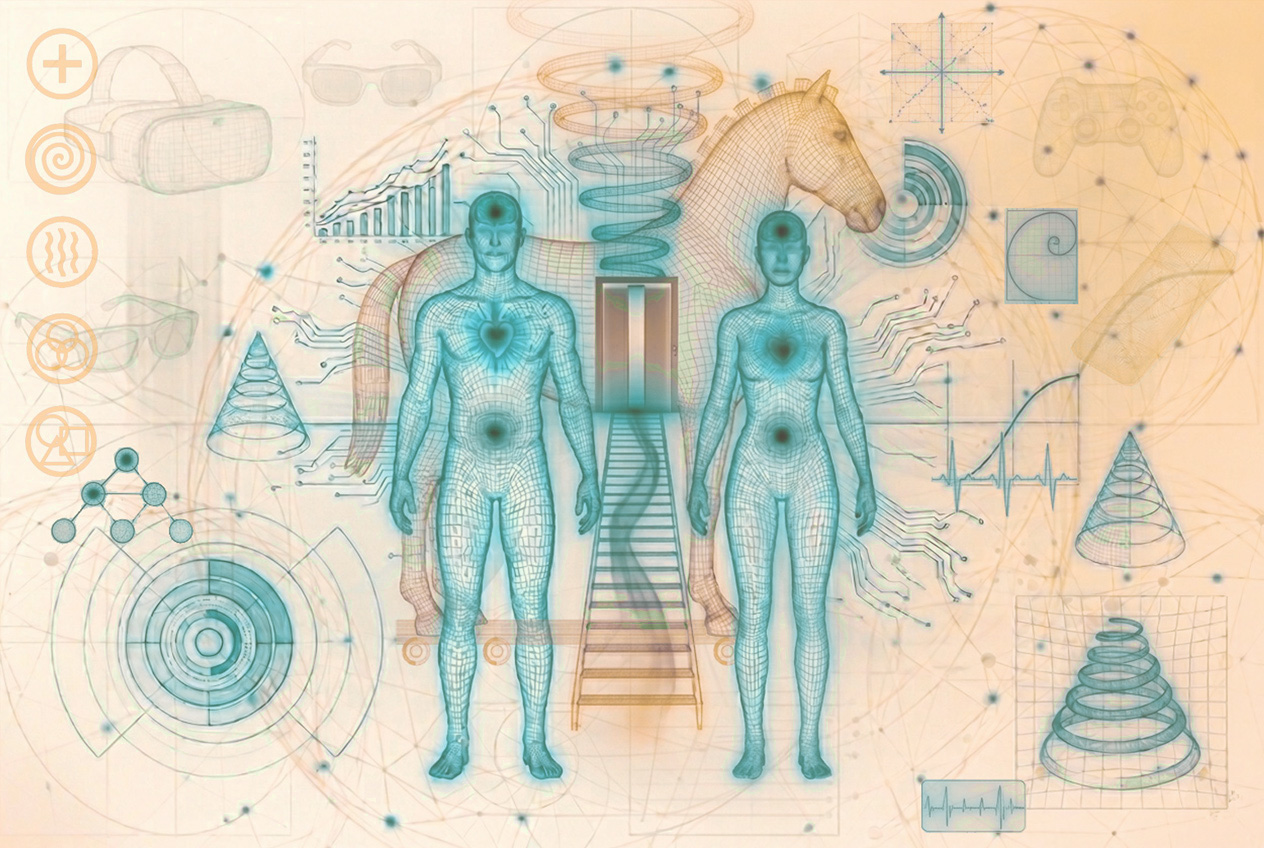


Communication · Many Channels


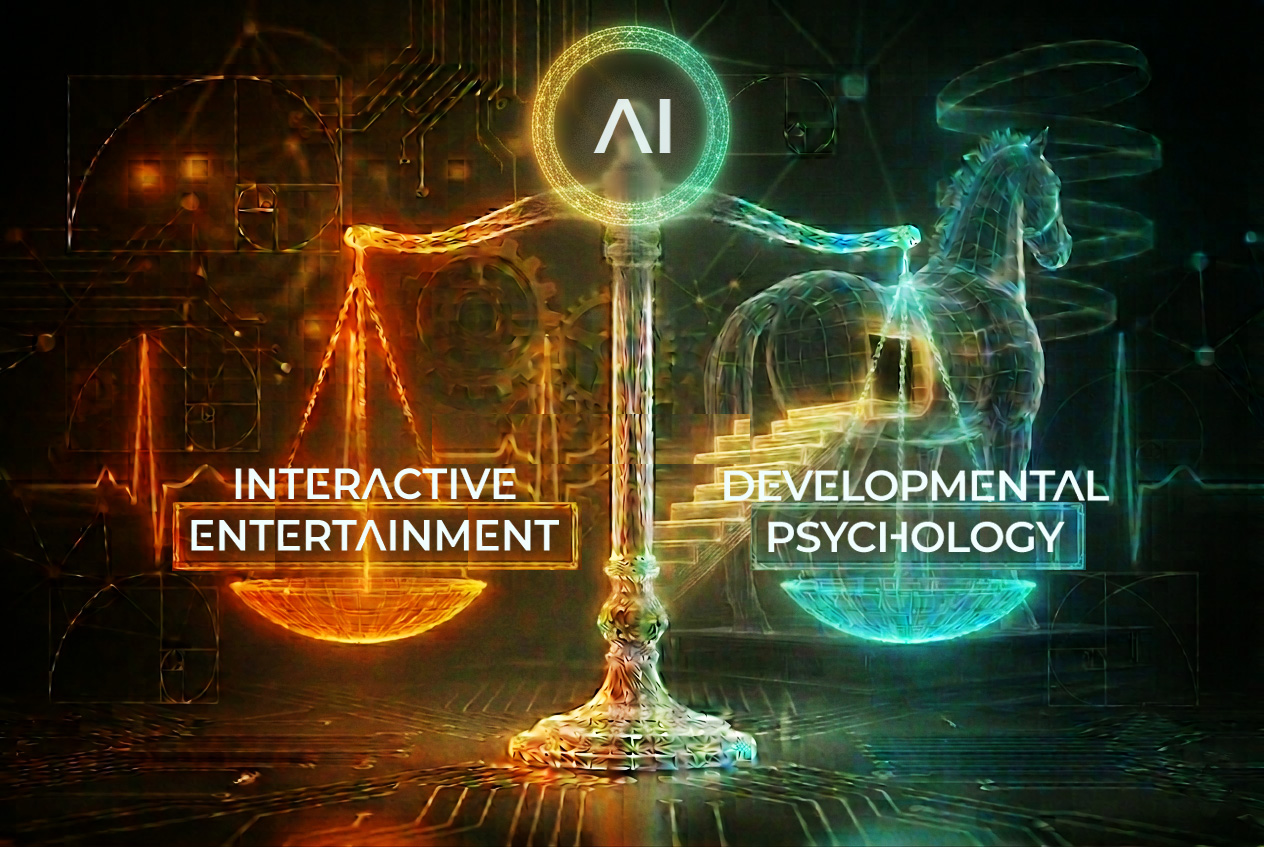


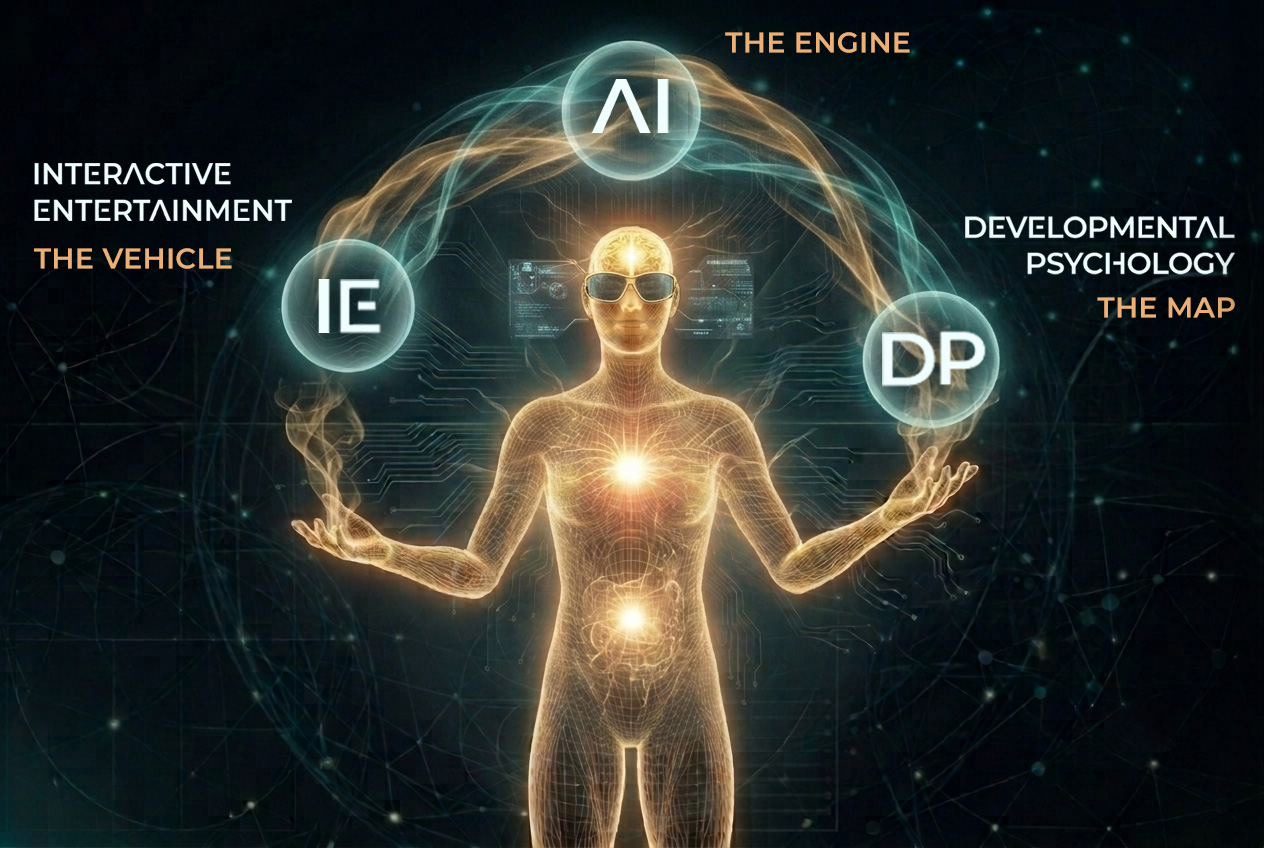


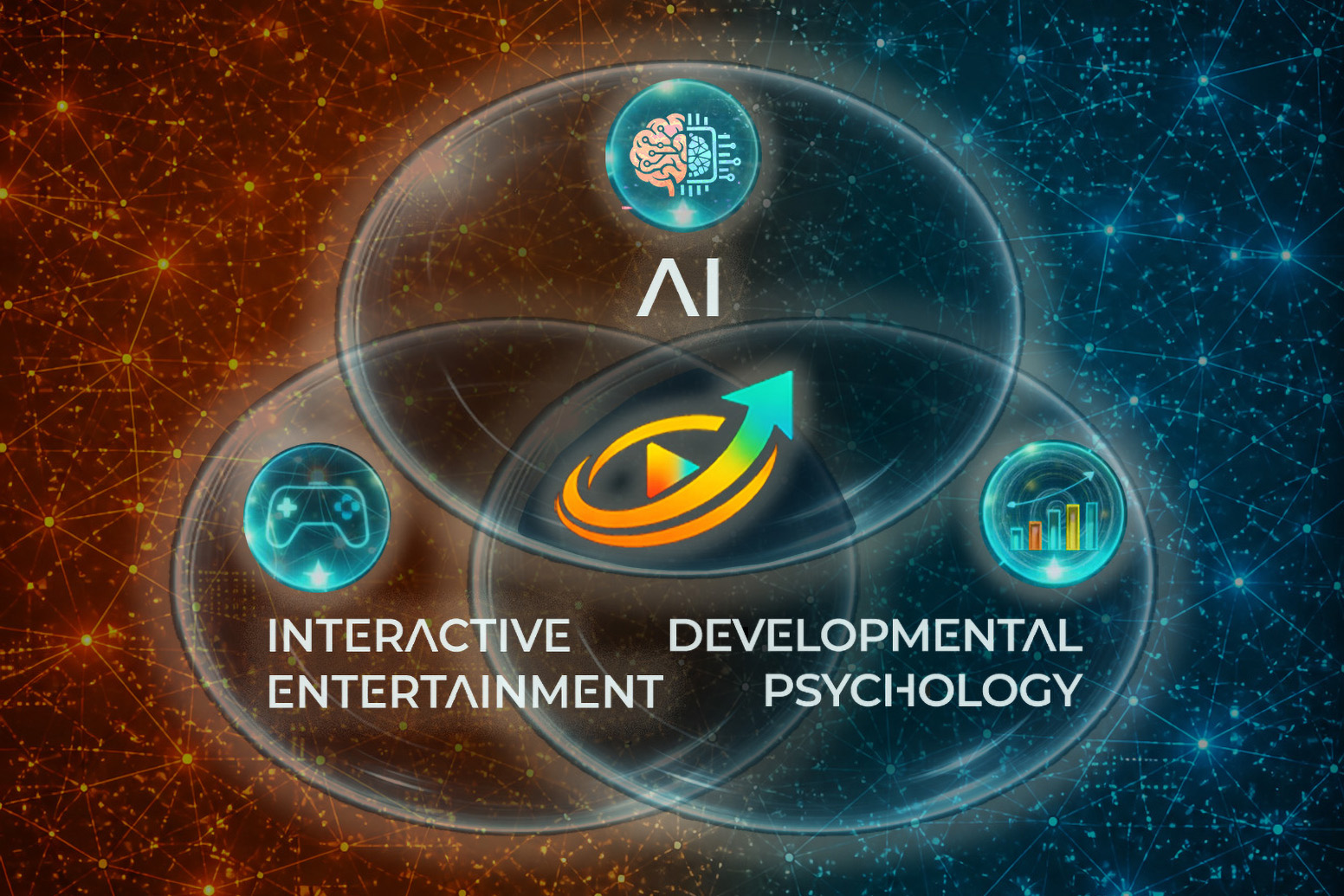


contact
On the same wavelength?
If this research resonates with you - whether you work in AI, Interactive Entertainment, or Developmental Psychology, or simply want to connect as a kindred spirit - let's talk.



Interactive Entertainment

© 2026 Press Play to Grow! All rights reserved.